
A New Era for AI Startups in Kenya
Kenya has taken a major step toward regulating artificial intelligence with the introduction of the Artificial Intelligence Bill, 2026. The Bill was introduced into parliament by Senator Karen Nyamu and is poised to undergo the structured legislative process before it becomes law.
For startups building AI-driven products, this is more than just policy, it is a fundamental shift in how innovation will be developed, deployed, and scaled. While the Bill aims to promote ethical, transparent, and accountable AI, it also introduces new compliance obligations that startups cannot afford to ignore.
What stakeholders should keep in mind when the bill reaches them for comment during public participation has been explored in a separate article. Here, the focus is on what Kenya’s AI Bill, 2026 means in practical terms for start-ups.
1. From Fast Innovation to Responsible Innovation
Startups are known for speed: build quickly, test, iterate.
However, Kenya’s AI Bill introduces a new expectation:
👉 AI systems must be safe, transparent, and accountable from the start
This is made so with the introduction of key requirements that include:
- Risk classification of AI systems
- Transparency in decision-making
- Safeguards against bias and discrimination
One of the most important aspects of the Bill is the classification of AI systems into:
- Unacceptable risk (prohibited)
- High-risk AI systems
- Limited risk
- Minimal risk
Why This Matters for Startups
If your product falls under high-risk AI systems, you must:
- Conduct risk assessments before deployment
- Carry out human rights impact assessments
- Ensure explainability of AI decisions
- Maintain records of datasets and outputs
Reference here is made to critical sectors, namely: healthcare, education, finance, agriculture, security, employment and public administration. As such, these could include systems that are involved in:
- Fintech and credit scoring
- Healthtech applications
- HR and recruitment tools
- EdTech systems affecting access to education
For many startups operating in these sectors , compliance becomes non-negotiable.
3. Compliance as a Competitive Advantage
While regulation may seem restrictive, it introduces a powerful shift:
👉 Trust becomes a competitive advantage
Startups that demonstrate:
- Responsible AI practices
- Data protection compliance
- Transparent systems
will be better positioned to:
- attract investors
- secure enterprise partnerships
- scale into regulated industries
In this new landscape, compliance is not just legal, it is strategic. It becomes a signal of maturity and reliability, helping startups stand out in increasingly crowded and scrutinized markets. By embedding trust and accountability into their operations, startups can turn regulatory alignment into a competitive advantage rather than a constraint.
4. The Hidden Challenge: Cost of Compliance
Let’s be realistic, compliance comes at a cost. Startups may need:
- legal advisory support
- technical audits
- documentation systems
- governance frameworks
For local startups with limited budgets, this creates potential challenges including:
- Higher barriers to entry
- Slower product development cycles
- Increased operational costs
Critiques have pointed to the prospects of these requirements stifling growth and (indeed) if not properly implemented, the law could disproportionately affect early-stage startups as well as small and medium enterprises (SMEs)
5. Regulatory Sandboxes: A Key Opportunity for AI Startups
One of the most promising aspects of the Bill is the introduction of regulatory sandboxes.
These allow startups to:
- test AI systems in a controlled environment
- innovate under regulatory supervision
- reduce legal risk during development
Why This Matters
Startups that engage early with sandboxes can:
- gain regulatory clarity
- build compliant products faster
- establish credibility with regulators
This is a major opportunity that many founders may overlook.
6. Generative AI and Legal Risk in Kenya
The Bill introduces strict rules for generative AI, including:
- Mandatory consent for use of likeness (image, voice, identity)
- Clear labelling of AI-generated content
- Liability for misinformation, defamation, or harm
For startups building with tools like AI text generators, image/video generation and voice cloning, this area presents significant legal exposure if not properly managed. Directors who do not take cognizance will be exposed to possible fines of up to KES 5,000,000, and imprisonment of up to 2 years or even both.
7. Practical Compliance Steps for Startups
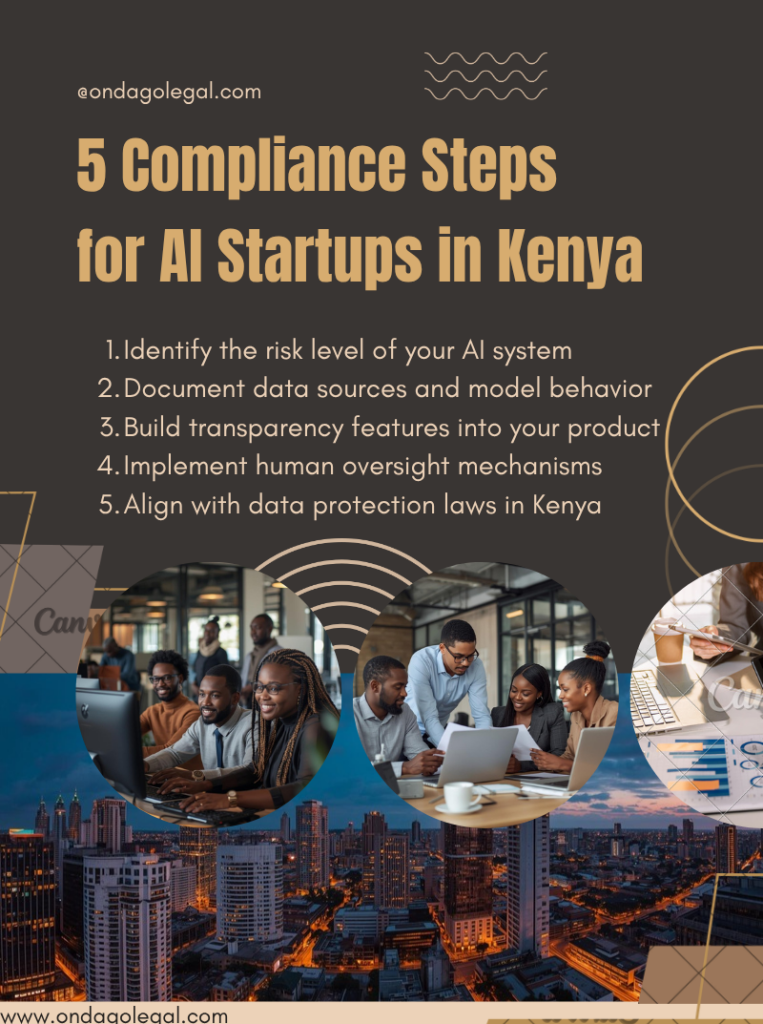
To stay ahead, startups should begin preparing now.
AI Compliance Checklist (Kenya)
- Identify the risk level of your AI system
- Document data sources and model behavior
- Build transparency features into your product
- Implement human oversight mechanisms
- Align with data protection laws in Kenya
Conclusion: The Future of AI Startups in Kenya
Kenya’s Artificial Intelligence Bill, 2026 is both an opportunity for responsible innovation and a challenge for startup agility.
The key takeaway is simple:
👉 AI regulation is here to stay
Startups that succeed will be those that:
- understand the law early
- integrate compliance into their systems
- build trust alongside innovation
Work With OndagoLegal
At OndagoLegal, we help startups and businesses navigate the legal and ethical complexities of emerging technologies, including:
- Data protection and privacy
- Digital assets and fintech regulation
- AI compliance and governance
Need tailored legal guidance on your AI system?
Contact Us today or Book A Consultation.
Leave a Reply